Playtesting
What We Learned from Our First Student Playtest
Five local high school students tested the prototype and gave us an encouraging first look at comprehension, curiosity, and usability.
HistoryQuest recently completed its first small playtest of One Afternoon in Red August 1966 with five local high school students. The session gave us an early opportunity to observe how teenage players responded to the prototype and where the experience needs further work.
The students played an early build containing a reconstructed Beijing neighborhood and the first missions. They explored the environment, interacted with historically inspired objects, and encountered the game's journal and contextual information.
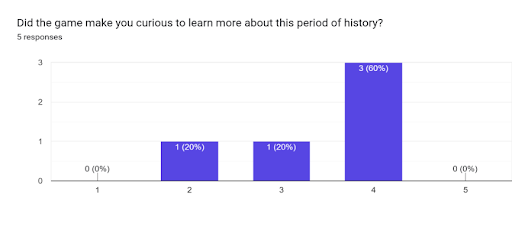
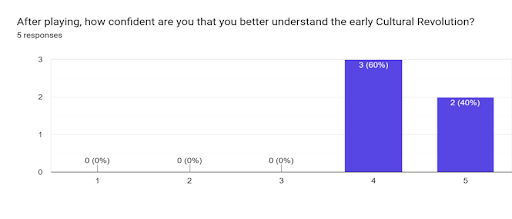
After playing, all five participants reported relatively high confidence that the experience helped them better understand the early Cultural Revolution. Three selected a rating of four and two selected a rating of five on a five-point scale. When asked whether the game made them more curious to learn about the period, three selected four, while the remaining two selected two and three.
These results are encouraging, especially because curiosity is one of the project's central goals. The game cannot teach an entire historical period in one short session. It can, however, give students enough context and personal engagement to make them want to ask further questions.
The playtest also has clear limitations. Five participants constitute a very small sample. Self-reported confidence does not demonstrate gains in historical knowledge, and these results do not establish how the game compares with another instructional method. We therefore view the results as formative feedback, not evidence that the game has achieved educational effectiveness.
The most useful outcome of an early test is not a positive score. It is a clearer list of questions for the next build. Can students understand the historical context without extensive assistance? Do they notice the information embedded in the environment? Does the journal clarify the experience? Which interactions create confusion? How should a teacher guide discussion after a mission?
Our next phase will include additional prototype testing focused on bugs, navigation, instructions, interface consistency, and areas of confusion. We also want to work with history teachers and an education-research partner to design a more rigorous classroom evaluation. That work may include pre- and post-experience questions, observation, structured reflection, and assessment of historical reasoning.
Testing difficult-history content also requires attention to student wellbeing. Future sessions should provide clear framing, appropriate consent and privacy protections, and an opportunity to discuss reactions after play.
The first five students helped us move from assumptions to observation. Their responses suggest that the concept merits further investigation. The next task is to improve the prototype and ask better questions with a larger and more carefully designed study.